
Internet in Cuba: timeline of a slow and costly evolution#
- Chapter #2 of Fonoma’s “Internet in Cuba” series
The year 1996 marked the beginning of Cuba’s access to internet services. Still, two decades would pass before expansion began. By 2006, only 11.2% of the population had managed to access the network of networks at least once.
From the limited spaces that existed, browsing was a privilege for a few, almost always tied to institutions or companies. It was not until 2009 that the government officially authorized free use by the population from post offices. But because prices were extremely high, enjoying the internet was still a utopia.
At that time, the slow and expensive connection worked through satellite links, because the island did not have a physical cable connecting it to the world. The situation changed in 2013 when, two years after its controversial installation, the submarine fiber-optic cable between Cuba and Venezuela began operating. Studies at the time placed the Caribbean nation last in Latin America, with a connectivity rate of 3%.
In June 2013, the first 118 public browsing rooms opened, set up in centers run by ETECSA, Cuba’s only telecommunications company. The price was 4.50 CUC per hour in a country where the average salary was below 25 CUC per month.
With this new service, called Nauta, users could also browse national sites for 0.60 CUC per hour, while combined access to the Cuban network and international email cost 1.50 CUC.
At the beginning of 2014, Nauta email arrived. It had a poor interface and plenty of flaws, but at least it allowed many people to make their first electronic communications.
WiFi zones / Nauta Hogar / Mobile data#
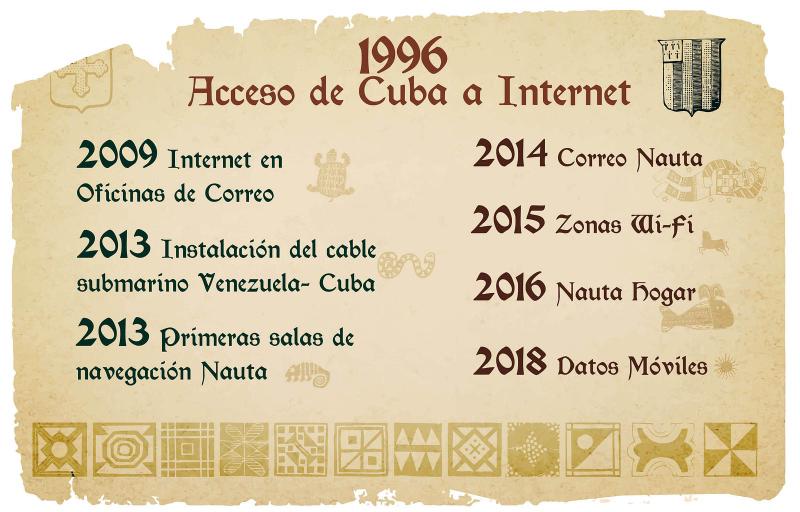
The following year brought encouraging news: the arrival of WiFi zones and a reduction in browsing rates to 2 CUC per hour. The first 35 wireless browsing points were located in public spaces such as parks, avenues, and boulevards. The number of people who could connect depended on each area’s configuration: 50 in small zones and 100 in larger ones.
The long-standing demand began to materialize at the end of 2016. Two decades after internet arrived in Cuba, a pilot test hinted at the long-awaited possibility of home access.
The test brought internet to 2,000 basic telephone customers in the Habana Vieja municipality, using outdated ADSL technology.
After months of testing came commercialization, with a maximum of 30 hours per month and rates between 10 and 70 CUC , depending on contracted speed. Today, about 170,000 homes have this service, barely 4.5% of the country’s households.
But the most important event in the island’s connectivity evolution happened on December 6, 2018, when the sale of mobile data packages began. At first, it was only on 3G. Almost a year later, 4G/LTE arrived with slightly lower rates. According to July 2020 data, about 2.5 million Cubans connect this way every month.
In the last three years, the Nauta Hogar home internet service has continued adding users very slowly. The numbers speak for themselves: at the end of December 2022 it had 269,440 households, increasing to 282,000 in November 2023 and reaching 290,000 customers in December 2024. That represents only 7.5% of all Cuban homes.
Meanwhile, in May 2025, ETECSA implemented new prices . One of the most significant measures is the limit of 360 CUP per month for national balance recharges. At the same time, it introduced “extra plans” in Cuban pesos and dollars, with very high prices.
Today, adding the three access channels together, WiFi zones, Nauta Hogar, and mobile data, around 7.5 million Cubans are internet users.
Although service prices have changed in recent years, they remain prohibitive for most of the population.
Fonoma is a service for recharges to Cuba .
